
NBA Injury Report Betting: Exploiting Line Moves and Absences
 Available in US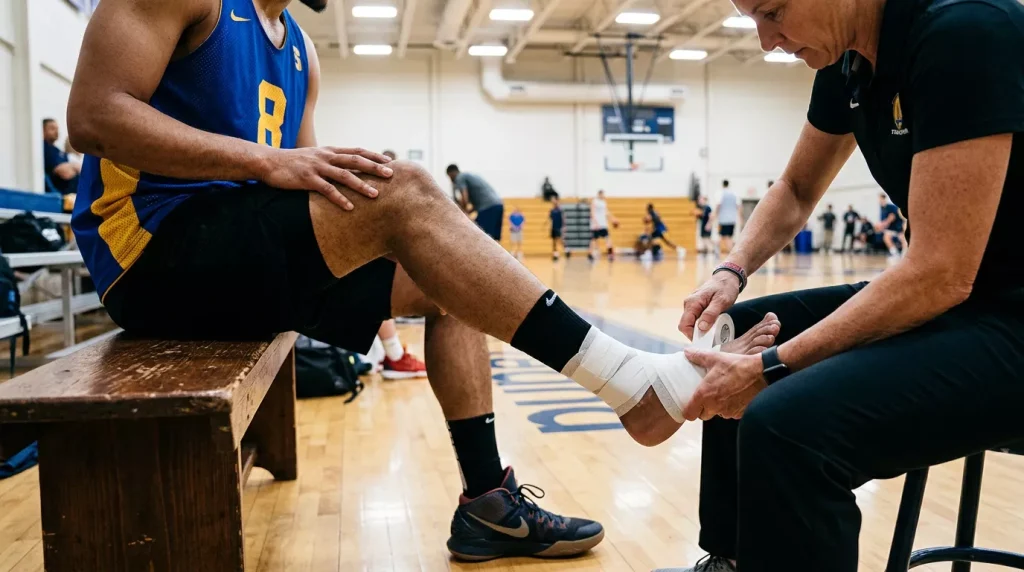
NBA Injury Reports: Betting on Questionable and Out Statuses
The NBA injury report cost me 400 pounds in a single week before I learned to read it properly. I was betting based on the previous night’s box score, not the current day’s availability update. A player who scored 35 points on Tuesday was listed as “out” with an ankle sprain on Wednesday, and I did not check because I assumed he would play. The spread I bet was built around his presence. He sat. The team lost by 15. Lesson learned, permanently.
The NBA requires all teams to submit injury reports by 17:00 Eastern time on game days — that is 22:00 GMT for UK bettors. Players are classified into four categories: probable (75%+ chance of playing), questionable (50/50), doubtful (25% or less), and out (will not play). These designations are mandated by league rules rather than voluntary disclosures, which means teams cannot hide injuries without risking fines. The reports are published on the NBA’s official injury report page and reproduced by every major sports news outlet within minutes.
The designations sound clear, but the reality is messier. “Questionable” is the most abused category — some teams use it to create uncertainty around players who are almost certainly playing, while others use it for players who are almost certainly sitting. Context matters: a player listed as questionable who has played through the same designation for his last six games is overwhelmingly likely to play. A player listed as questionable who missed the previous game with the same injury is a genuine coin flip. Reading injury reports is not about the label; it is about the pattern behind the label.
Quantifying the Impact of Star Player Absences on NBA Lines
Not all absences are equal. When a team’s 12th man misses a game, the spread barely moves. When a top-five player misses a game, the line can swing by 3-5 points — and sometimes more. The size of the adjustment depends on the player’s role, the team’s depth, and the opponent.
An XGBoost study using SHAP analysis identified field goal percentage, defensive rebounds, and turnovers as the key performance indicators that predict NBA outcomes across all game segments. Star players dominate these categories. When a high-usage player who accounts for 30% of his team’s offence sits out, the team’s field goal percentage drops because lesser players take on a larger shot diet. Their turnovers increase because the replacement player is less experienced under defensive pressure. The cumulative effect on the team’s performance is larger than the raw per-game statistics of the absent player suggest, because the absence disrupts the entire offensive ecosystem.
I maintain a personal database of how specific teams perform with and without their star players. The sample sizes for any single player are small — maybe 10-15 games per season — but the directional patterns are remarkably consistent. Teams with elite depth (8-9 quality rotation players) absorb star absences much better than teams that lean heavily on their top two players. When a star is ruled out, the first question I ask is not “how good is this player?” but “how deep is this team?” The answer determines whether the line has moved enough or not enough.
Adam Silver once described feeling deeply disturbed by threats to the league’s competitive integrity. That concern extends to information asymmetry around injuries. If a player’s status is ambiguous and insiders know the outcome before the public, the line moves before the report is published. Watching for pre-report line movement is one way to infer what the smart money already knows — a spread that drifts from -5 to -3.5 an hour before the injury report drops is the market pricing in a likely absence before the official confirmation.
Speed Matters: How to React to Late NBA Injury News from the UK
The window between an injury update and the market’s full adjustment is measured in minutes, not hours. When a star player is ruled out 90 minutes before tip-off, the spread on major US sportsbooks moves within seconds. UK platforms follow within one to five minutes. If you can act in that gap, you capture the pre-adjustment line. If you wait 10 minutes, the value is gone.
From the UK, this means having a system in place before injury news breaks. I use push notifications from the NBA’s official app and two independent injury tracking accounts on social media. When a notification fires, I already know which games I am interested in and what my pre-injury projection was. The question is not “should I bet this game?” — I have already answered that during my afternoon research. The question is “has the line moved enough to reflect the absence, or is there still value?”
In-play betting revenue accounted for 62.35% of online betting revenue in 2025, and the speed of information flow in live markets makes injury timing even more critical during games. A player who turns an ankle in the second quarter might not return, and the live line adjusts incrementally as his absence becomes more certain. The first adjustment — when the player goes to the locker room — is usually an overcorrection because the market assumes the worst. The second adjustment — when the team announces he will not return — is more measured. If you are watching the game and see the initial overcorrection, there is a brief window to bet against the panic before the line settles at a more accurate level.
The UK time zone works against you for live injury news because most games are in progress between midnight and 04:00 GMT. I handle this by selecting my live-betting nights in advance, focusing on games where injury-driven line movements are most likely — typically games featuring players on the injury report as “questionable” or “game-time decision.” On those nights, I stay up. On other nights, I place my pre-game bets and go to sleep, accepting that the live opportunities are not worth the sleep deprivation.
For a systematic framework on how to incorporate injury data alongside schedule, matchup, and statistical analysis, my guide on NBA spread betting strategy lays out the step-by-step process.
Articles



Written by the editors at CourtEdge.
