
NBA Live Betting Strategy: Exploiting In-Play UK Markets
 Available in US
I resisted live betting for years. My entire approach was built on pre-game analysis — schedule spots, ATS trends, injury reports — and the idea of making decisions in real time, with the clock running and the odds shifting every possession, felt like the opposite of disciplined betting. Then I looked at the numbers. In-play wagers accounted for 62.35% of online betting revenue in 2025. More than three-fifths of all money flowing through legal sportsbooks was being staked after the opening whistle. The market had moved, and I was ignoring the biggest room in the building.
What changed my mind was not the volume itself but what I discovered underneath it. Live NBA markets are less efficient than pre-game markets. The bookmaker’s algorithm reprices every few seconds based on the score, the game clock, and a handful of statistical inputs. But it cannot process context the way a human watching the game can. It does not see a team’s defensive intensity shifting. It does not recognise when a coach’s timeout adjustment has changed the tactical shape of the game. It does not know that a player is visibly limping but has not been subbed out yet. Those gaps between what the algorithm prices and what is actually happening on the court are where live betting edges live.
This guide covers the fourth-quarter dynamics that reshape NBA live markets, how to read momentum shifts without falling for noise, a halftime recalibration system for totals, what to look for in UK live betting platforms, and the risk controls that keep live betting from becoming the fastest way to drain a bankroll. Everything is geared toward UK bettors dealing with late-night tip-offs and decimal odds.
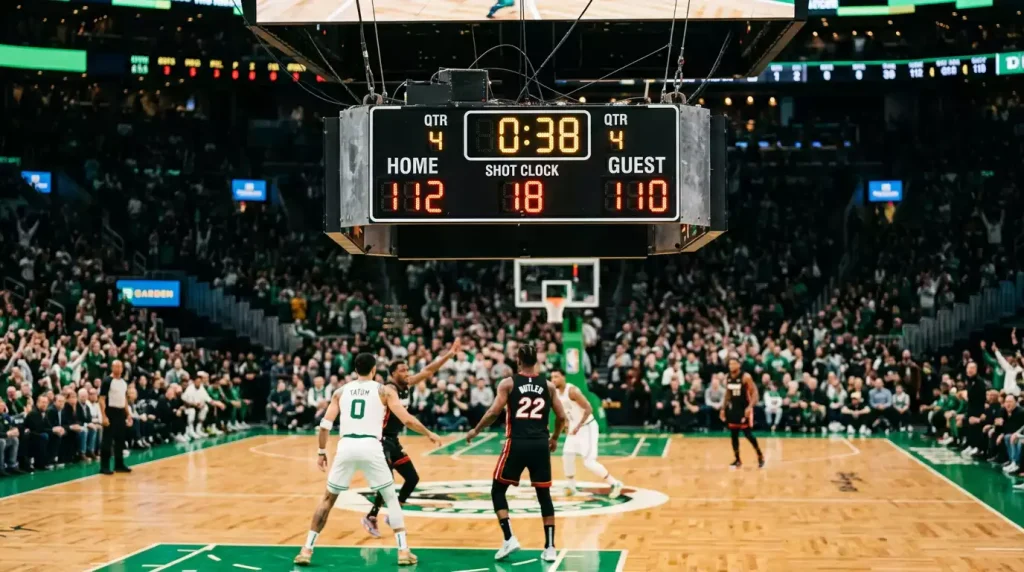
In-play dynamics shift drastically late in the game, which is why mastering NBA fourth-quarter betting is crucial for maximizing your live wagers.
Fourth-Quarter NBA Live Betting: Pace and Line Shifts
Roughly 19% of NBA games are decided in the fourth quarter — defined as games where the margin is within ten points entering the final period. That number comes from an analysis of over 2,295 games across a ten-year span, and it reshaped how I think about live betting entirely. One in five games is still genuinely up for grabs with 12 minutes to play, and the dynamics of those final minutes are fundamentally different from everything that came before.
The pace drops. Median possession counts in close fourth quarters sit between 90 and 100, significantly lower than the first half. Teams slow down deliberately. The trailing team milks the clock less — they push tempo — but the leading team controls the game’s rhythm, and the net effect is fewer possessions per minute. Fewer possessions mean fewer scoring opportunities, which means the live total line needs to be adjusted downward more aggressively than most bookmaker algorithms manage. I have found consistent value on fourth-quarter unders in close games, precisely because the algorithm prices fourth-quarter scoring based on the game’s average pace rather than the compressed pace that close games actually produce.
Fouls rise simultaneously. Physical work output declines measurably between the first and fourth quarters — García et al. documented an effect size of -1.27 — and tired players foul more. Intentional fouls compound this in the final two minutes of close games, sending the trailing team to the free-throw line repeatedly. Free throws slow the game clock, inflate the raw point total, but do so inefficiently — teams shoot roughly 78% from the line, meaning each trip to the stripe produces fewer points per possession than a normal half-court set. The scoring in the final minutes looks busy in the box score but is actually lower-quality and lower-volume than the rest of the game.
For a dedicated breakdown of how these Q4 patterns translate into specific live systems — including a close-game model and fourth-quarter totals strategy — the fourth-quarter betting guide covers the data in granular detail.
Reading Momentum Shifts: When to Enter and Exit Live Bets
Momentum is the most dangerous word in live betting. Everyone thinks they can see it, and almost no one can distinguish real tactical shifts from random scoring variance. I have fallen into this trap more times than I care to admit — watching a team score eight straight points, deciding the game has “turned”, and placing a live bet just before the other team responds with a 12-0 run of their own.
True momentum shifts in the NBA are not about scoring runs. They are about structural changes in how the game is being played. A coach calling a timeout and switching from a drop coverage to a switch-everything defence is a structural change. A bench unit entering the game and immediately increasing the pace by five possessions per quarter is a structural change. A star player picking up his fourth foul early in the third quarter and sitting down is a structural change. These shifts alter the game’s trajectory in predictable ways, and the live betting algorithm takes time to catch up because it is reacting to the scoreboard, not to the tactical adjustment itself.
I watch for three specific signals before entering a live bet. First, a coaching adjustment that changes the defensive scheme — visible in how the team guards pick-and-roll action. If a team switches from hedging to blitzing, the opponent’s half-court efficiency drops immediately while they adjust, and the live spread often has not moved yet. Second, a rotation change that puts a significantly different unit on the floor. When a team’s second unit outperforms expectations in the second quarter, the live line overreacts to the bench’s hot shooting and underweights the regression that is almost certainly coming. Third, foul trouble for a key player. The algorithm adjusts the live spread by a point or two when a star sits with foul trouble, but it often undershoots the impact on the team’s defensive identity.
Exit signals are simpler. I set a target when I enter every live bet: a specific spread number or moneyline price at which I will cash out or let the bet ride to completion. If the game moves in my favour and hits my target price, I reassess. If the structural reason for my bet has resolved — the coach has switched the defence back, the star has returned from foul trouble — I cash out regardless of the current score. Holding a live bet after the catalyst has expired is gambling on noise, and noise does not have an edge.
There is a fourth signal I watch for, though it fires less frequently: a dramatic shift in free-throw disparity. When one team suddenly starts getting to the line at twice the rate of their opponent in the second or third quarter, it usually indicates a change in defensive aggression — one team is fouling more because they are reaching on defence, which means they are tired or frustrated. That foul-rate shift is a leading indicator of a coming scoring run for the team getting to the line, and the live spread often lags because the algorithm sees the free throws as isolated events rather than a symptom of a broader defensive breakdown.
The Halftime Recalibration System for NBA Totals
Halftime is the single best moment to place a live totals bet. The first half has given you 24 minutes of actual data — shooting percentages, pace, foul rates, rotation patterns — and the bookmaker’s halftime line is a simple projection: take the first-half score and roughly double it, with a slight adjustment for expected pace changes. That projection is crude, and it is where my most consistent live edge has emerged over the past four seasons.
The system works like this. Before the game, I note the pre-game total — say 221.5. At halftime, the combined score is 98. The naive projection says the game is on pace for 196, well under the pre-game total. The live halftime total might be set at 210.5. My job is to determine whether 210.5 is right.
I look at three inputs. First, first-half three-point shooting for both teams. If one team shot 50% from three in the first half on 20 attempts, that is almost certainly going to regress toward their season average of 35-37% in the second half. That regression alone could suppress the second-half scoring by six to eight points compared to the first half. Second, I check whether the first-half pace was typical for these teams or inflated by early-game turnovers and fast breaks that tend to settle down in the second half. Third, foul trouble. If either team’s primary defenders are in foul trouble, the second-half defence will be weaker, which pushes scoring higher.
When two of these three inputs point in the same direction — say, three-point regression and pace normalisation both suggest lower second-half scoring — I bet the under at the halftime line. When all three conflict, I pass. The in-play share of online betting revenue, at over 62%, means there is enormous liquidity in these halftime markets, which keeps the odds competitive and the margins tight. That liquidity benefits the bettor because it means you can get in and out of positions without moving the line against yourself.
The discipline here is resisting the temptation to bet every halftime. I place a halftime totals bet in roughly one out of every four games I watch. The other three either lack a clear directional signal or have a halftime line that already reflects the first-half data accurately. Passing on a well-priced line is not leaving money on the table — it is recognising that there is no money on the table.
One refinement I added last season: tracking the gap between the pre-game total and the projected full-game score at halftime. When that gap exceeds eight points in either direction — the game is on pace for 230 when the pre-game total was 222, or on pace for 200 when the pre-game total was 220 — the halftime line tends to overcorrect. The bookmaker assumes the second half will partially revert to the pre-game expectation but not fully, which creates a line that sits awkwardly between the first-half pace and the pre-game number. In high-gap situations, betting toward the pre-game total — under when the pace has been unusually high, over when it has been unusually low — has been profitable in my records because regression to the mean is stronger than the halftime algorithm anticipates.
Stay ahead of the bookmakers by following the best NBA betting systems updated daily by our team of experts.
Best UK Platforms for NBA Live Betting: Latency and Features
Live betting on NBA games from the UK comes with a unique challenge: latency. The game is happening thousands of miles away, the video feed is delayed by anywhere from two to fifteen seconds depending on your streaming source, and the bookmaker’s odds are updating based on a data feed that runs ahead of your screen. If you are watching on a delayed stream and the bookmaker has already priced in a basket you have not seen yet, you are betting blind.
The latency gap matters less for halftime bets and fourth-quarter totals, where you have minutes to assess and the line is relatively stable. It matters enormously for in-play spread bets placed during a run, where the odds shift every few seconds. I mitigate this by using the fastest available stream — typically the bookmaker’s own embedded stream, which is synced to their data feed — and by avoiding bets during live action. I place my live bets during timeouts, between quarters, and at halftime, when the market is paused and the latency gap closes to zero.
UK bookmakers vary significantly in their NBA live betting coverage. Online revenue from real sports events in the UK reached GBP596 million in early 2025, a 5% year-on-year increase, and basketball’s share of that total has been growing as the NBA’s global audience expands. The UKGC-licensed platforms that offer the broadest NBA live markets tend to include in-play spreads, totals, quarter lines, and player props that update throughout the game. Smaller platforms may only offer moneyline and basic spread markets in-play, which limits your options.
What I look for in a live betting platform: speed of odds updates, depth of NBA markets, quality of the embedded stream, and the availability of cash-out during live play. Cash-out lets you close a position before the game ends — effectively locking in a partial profit or cutting a loss. Not every platform offers cash-out on NBA in-play bets, and the ones that do sometimes suspend it during volatile moments, precisely when you most want to use it. Test the cash-out function on a small bet before relying on it in a high-stakes spot.
Controlling Risk in Live NBA Markets
Adam Silver, the NBA commissioner, has said repeatedly that if the game is not viewed as honest and the competition is not on the level, the league will lose its fan base. That statement is about integrity, but it applies equally to your personal betting integrity. Live betting is the fastest way to lose discipline because it feels different from pre-game betting. The action is immediate, the feedback loop is instant, and the emotional pull is orders of magnitude stronger. One bad live bet leads to a revenge bet, which leads to a doubling of stakes, which leads to the kind of session that responsible gambling research warns about.
My live betting risk controls are stricter than my pre-game rules. I cap live bets at two units per game, regardless of how many opportunities I identify. I never place a live bet within the first five minutes of a quarter, because the scoring is too noisy to read and the odds are updating too quickly for me to assess value. I set a hard stop-loss of three units per live betting session — if I lose three units on live bets in a single night, I close the app and go to bed. NBA games tip off between 11 p.m. and 3:30 a.m. UK time. The combination of fatigue, late-night decision-making, and the adrenaline of live odds is a recipe for impulsive betting if you do not have guardrails in place.
I also separate my live betting bankroll from my pre-game bankroll in my tracking spreadsheet, even though they draw from the same pot. The separation is purely for analysis: I want to know whether my live bets are producing positive expected value independently or whether they are diluting the returns from my more disciplined pre-game system. For the first two seasons I tracked live bets separately, they were net negative. It took a full year of refining my entry signals and tightening my risk rules before live betting became a consistently profitable addition rather than an exciting drain.
The single most important risk control is also the simplest: never place a live bet you did not plan for. Before tip-off, I identify specific scenarios that would trigger a live bet — a halftime total that looks mispriced, a potential fourth-quarter under in a close game, a foul trouble situation for a key defender. If none of those scenarios materialise, I do not bet. The game might be thrilling, the swings might be dramatic, but if my pre-identified triggers are not met, I am a spectator, not a bettor. That distinction is everything.
NBA Live Betting Questions Answered
Articles

Published by the CourtEdge team.
