
NBA Prediction Market Betting: Exchanges vs Bookmakers
 Available in US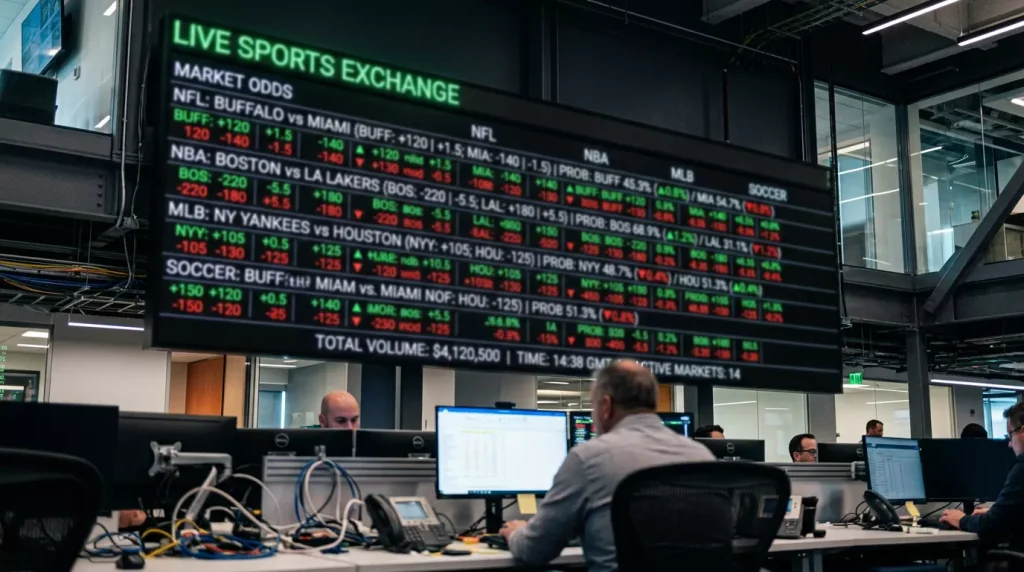
NBA Prediction Markets: Evaluating Exchange Odds Pricing
I first noticed prediction markets when a colleague mentioned he was buying “shares” in the Celtics to win the championship. Not betting — buying shares. That framing stuck with me, because it captures the fundamental difference between prediction markets and traditional bookmakers. A bookmaker sets a price and takes your bet. A prediction market lets buyers and sellers determine the price themselves, just like a stock exchange.
In a prediction market, an NBA outcome — say, “Boston Celtics win the 2026 NBA Championship” — trades as a contract priced between 0 and 100. If the contract is trading at 32, the market implies a 32% probability that the Celtics win the title. If you think the true probability is higher, you buy. If lower, you sell. When the outcome is decided, winning contracts pay 100 and losing contracts pay zero. Your profit or loss depends on the gap between your purchase price and the final settlement.
This exchange-based structure eliminates the bookmaker’s traditional margin. There is no house setting the line and baking in a 4-5% commission. Instead, the platform charges a small transaction fee (typically 1-2%) and the price is determined entirely by the balance of supply and demand among participants. In theory, this produces more accurate prices because the market aggregates information from all participants rather than relying on a single bookmaker’s model.
In practice, NBA prediction markets are thinner than traditional bookmaker markets. The volume on a championship futures contract might be a few million dollars, compared to hundreds of millions flowing through regulated sportsbooks. That thinner volume means prices can be more volatile and less efficient on a game-by-game basis, even if the overall championship pricing is reasonably accurate.
The Regulatory Landscape: Prediction Markets, Tax Revenue, and UK Access
Prediction markets sit in a regulatory grey zone that has drawn increasing scrutiny from both US legislators and UK regulators. The American Gaming Association estimates that prediction markets diverted more than $500 million in potential tax revenue from regulated sports betting since early 2025. That figure has made prediction markets a political target — state regulators see them as competitors that enjoy lighter oversight while siphoning revenue from the licensed betting industry.
The tax argument is straightforward. Regulated US sportsbooks generated record tax revenue of $3.71 billion in 2025 — a 32.4% increase over the previous year. Prediction markets, operating under different regulatory frameworks, contribute far less to state coffers. Bill Miller of the AGA has argued that sports betting belongs under state and tribal regulation because that is how consumers are protected and communities share in the benefits. The implication is clear: prediction markets that offer functionally identical products without equivalent regulation threaten the sustainability of the licensed market.
For UK residents, the regulatory question is more nuanced. The UK Gambling Commission regulates betting activities conducted by UK-licensed operators, but many prediction market platforms are based offshore and do not hold UKGC licences. Using these platforms is not explicitly illegal for UK residents in most cases, but it falls outside the consumer protections that licensed operators provide — no deposit guarantees, no dispute resolution, and no responsible gambling tools. The approximately 2.7 billion pounds wagered annually on unlicensed platforms in the UK illustrates the scale of activity that occurs beyond the Gambling Commission’s reach.
I treat prediction markets with the same caution I apply to any unregulated financial instrument: useful as an information source, risky as a betting vehicle. The prices they generate can inform your traditional bookmaker bets — but placing your actual money outside the regulated framework introduces counterparty risk that no edge can justify.
Using Prediction Market Prices as a Signal for Bookmaker Bets
The most practical use of prediction markets for UK NBA bettors is not placing bets on them — it is reading their prices as a complementary data source for your bookmaker betting.
Prediction market prices reflect the collective belief of a participant pool that includes sharp bettors, casual fans, data scientists, and institutional traders. When a prediction market prices an NBA championship contract significantly differently from a bookmaker’s implied probability, one of them is wrong. The question is which one, and the answer often depends on the market’s thickness. For championship futures, where both markets are reasonably liquid, convergence is typical and persistent divergence signals a genuine mispricing. For individual game outcomes, where prediction market volume is much thinner, the bookmaker’s price is usually more reliable.
I check prediction market championship prices once a week during the NBA season and compare them to my bookmaker’s futures odds. If the prediction market prices a team at 18% to win the title and my bookmaker has them at 12.00 (implied 8.33%), the gap suggests one market has information the other does not. Further research — recent performance, injury news, schedule difficulty — usually explains the divergence and helps me decide whether the bookmaker’s price represents value.
The signal is most useful during the trade deadline and playoff windows, when new information arrives rapidly and different markets absorb it at different speeds. A prediction market might reprice a team’s championship contract within minutes of a blockbuster trade, while a UK bookmaker’s futures line takes hours to adjust. If you spot the adjustment on the prediction market first, you can bet the bookmaker’s stale price before it moves. That window is narrow — usually 30-60 minutes — but it can be extremely profitable for the prepared bettor.
There is also a defensive use for prediction market data. When a prediction market and a bookmaker agree closely on a probability, it suggests the consensus is strong and the market is efficient — which means your edge on that bet is likely thin. I use agreement between the two as a “pass” signal rather than a “bet” signal. If both markets are pricing the Celtics at 25% to win the title and my own analysis says 26%, the discrepancy is too small to justify tying up capital in a futures bet for months. Convergence between prediction markets and bookmakers is a sign that the price is right, and betting into a correct price is how you pay the bookmaker’s margin for nothing. For a deeper understanding of how price efficiency works across different NBA sub-markets, my guide on NBA market efficiency covers the broader framework.
Articles



Prepared by the CourtEdge editorial staff.
