
NBA Fourth-Quarter Betting: Live Systems for Close Games
 Available in US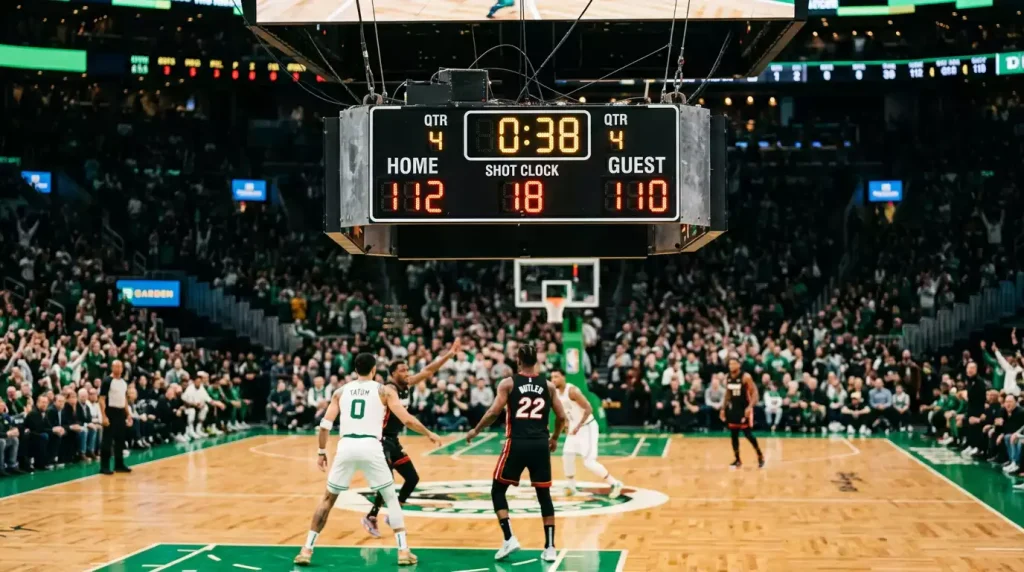
Q4 NBA Betting Metrics: Pace Drops and Late-Game Fouls
I spent an entire season tracking fourth-quarter scoring patterns before I placed a single live bet based on Q4 data. What I found changed my approach to in-play NBA betting permanently. The fourth quarter is not just a continuation of the first three — it is a structurally different period of basketball with its own pace, its own foul dynamics, and its own scoring profile.
The numbers are stark. The median pace in fourth quarters of close games drops to 90-100 possessions, well below the first-half tempo. That pace drop is not random — it reflects deliberate strategic choices by coaches. Teams protecting a lead slow the game down, running clock and taking late shot-clock attempts. Teams trailing speed up, pressing defensively and pushing in transition. But the net effect of these opposing strategies is still a slower pace than the first three quarters, because the leading team’s clock management has a larger impact on total possessions than the trailing team’s urgency.
The foul rate spikes in the opposite direction. Trailing teams foul intentionally to stop the clock, sending opponents to the free throw line for two shots that reset the shot clock and kill another 15-20 seconds. A tight game that produced three fouls per quarter in the first three periods might generate eight or nine in the fourth. Those fouls create free throw points that inflate the final score but reduce field goal attempts and suppress the fast-paced, high-variance scoring that characterises the first half.
Garcia et al. measured a physical performance decline with an effect size of -1.27 between the first and fourth quarters. That fatigue layer sits underneath the strategic factors. Tired players make worse decisions, take lower-quality shots, and defend with less intensity. The combination of strategic slowdown and physical deterioration creates a fourth quarter that averages 3-5 fewer points per team than the first quarter, depending on the game’s competitiveness.
A System for Close Games Entering the Fourth Quarter
Wang et al. analysed 2,295 NBA games over a decade and found that 19% were decided in the fourth quarter — meaning the outcome was still genuinely uncertain entering the final period. That 19% figure translates to roughly 230 games per regular season where your fourth-quarter read determines the bet’s outcome.
My system for these close games is built on a single principle: the team that controls pace in the fourth quarter wins. Not the team with more talent. Not the team with momentum. The team that dictates the tempo. A leading team that successfully slows the game to a half-court grind wins the fourth quarter at a rate above 65% in close games. A trailing team that successfully accelerates pace and forces turnovers overcomes the deficit roughly 35% of the time — which is lower than most people expect, because the leading team’s strategy is simply more reliable than the trailing team’s desperation.
Practically, this means I look for two triggers when a game enters the fourth quarter within six points. First: is the leading team capable of executing half-court offence without relying on transition? Teams with strong half-court sets — ball movement, multiple shooters, a go-to isolation scorer — maintain their lead in close games far more effectively than teams that depend on pace and athleticism. Second: does the trailing team have a defensive identity that generates turnovers? If not, their ability to speed up the game is limited, and the leader’s pace control will hold.
When both triggers align — a leading team with elite half-court offence facing a trailing team with a poor turnover-creation rate — I take the live spread on the leading team if the line offers value. The market often underestimates the difficulty of coming back in the fourth quarter because the public loves comeback narratives and over-bets trailing teams.
There is a secondary filter I apply for games within three points. At that margin, the trailing team does not need to press as aggressively, which means the pace drop is less severe and the outcome is more coin-flip than the six-point close-game category. I usually pass on these razor-thin margins unless one team has a clear free-throw shooting advantage — because late-game fouls decide these contests, and a team shooting 82% from the line has a structural edge over a team at 72% in the final two minutes. Free-throw differential is the single most underrated factor in Q4 betting.
Fourth-Quarter Totals: Unders in Close Games, Overs in Blowouts
The totals market in the fourth quarter behaves in a way that seems counterintuitive until you break down the mechanics.
In close games, the pace drop and foul dynamics described above suppress total scoring. The leading team takes time off the clock, the trailing team fouls to stop it, and both teams run through their star players until fatigue degrades shot quality. Fourth-quarter unders in close games — games within 8 points entering Q4 — have been one of my most consistent live-betting angles over the past four seasons.
In blowouts, the opposite happens. The leading team pulls its starters midway through the fourth quarter, inserting bench players who lack the discipline to maintain defensive structure. The trailing team’s bench unit, often playing for individual contracts and future opportunities, attacks aggressively and takes quick shots. The result is a sloppy, up-and-down fourth quarter that often produces more combined points than any other period in the game. Fourth-quarter overs in blowouts are less reliable than close-game unders because the bench-unit scoring is highly variable, but the lean is clear.
The practical challenge for UK bettors is timing. Most NBA games reach the fourth quarter between 01:30 and 04:30 GMT. Placing a live Q4 bet requires you to either stay up for the game or set alerts for close-game situations. I use score-tracking apps that notify me when a game is within six points entering the fourth quarter, which lets me make a quick assessment and place the bet without watching the entire game. It is not ideal — you miss context that a live viewer would catch — but it is a workable compromise for the time zone gap.
One nuance worth noting: the fourth-quarter totals angle works best in the middle of the season, from December through March. Early-season games have less predictable rotation patterns, and late-season games feature load management that distorts which players are on the court. The meat of the NBA schedule — when rotations are set, motivations are clear, and sample sizes support your projections — is where Q4 totals betting delivers its most consistent edge.
The fourth quarter is where casual bettors panic, where narratives take over, and where the live market gets sloppy. For a deeper look at how these dynamics fit into an overall approach to in-play wagering, I have covered the full framework in my NBA live betting strategy guide.
Articles


Created by the "CourtEdge" editorial team.
