
NBA Line Movement Strategy: Reading Sharp Money Dynamics
 Available in US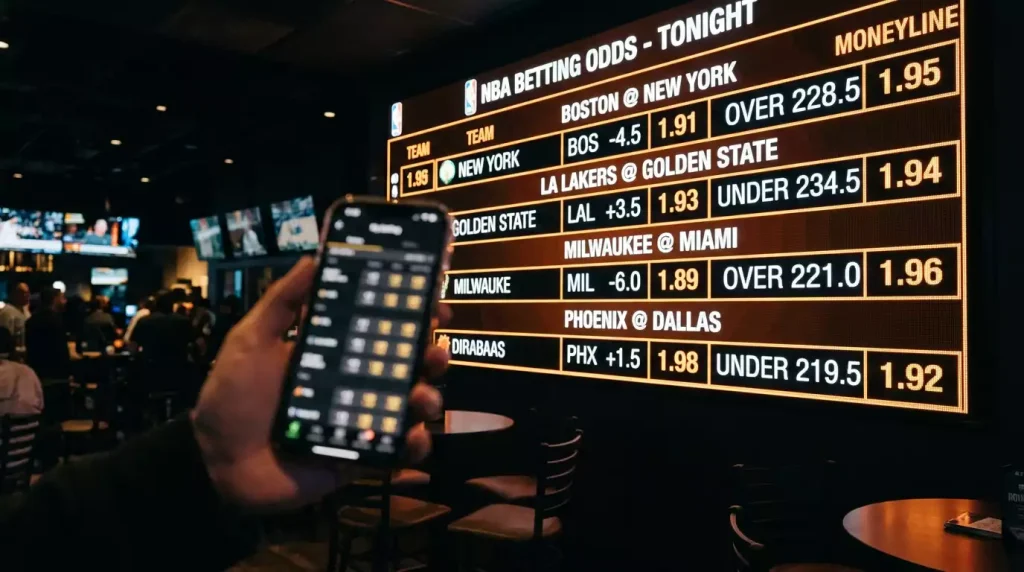
Tracking NBA Line Movement: Sharp Money and Public Bias
I used to think line movement was just noise — numbers flickering on a screen between the time I saw the opening line and tip-off. Then I tracked a full season’s worth of opening-to-closing movements alongside my betting results and discovered something unsettling: the games where I bet against the closing line’s direction were my worst performers by a wide margin. The line was telling me something, and I was ignoring it.
NBA lines move for three primary reasons. Sharp money — large, well-informed bets from professional syndicates — is the biggest mover. When a respected account drops a significant wager at a major bookmaker, the odds adjust immediately. Other bookmakers follow within minutes, creating a cascade that shifts the entire market. Sharp action typically comes in early, often within the first hour of lines opening, because professionals want to capture the least efficient price before the market corrects.
Injury news is the second driver and the one most UK bettors underestimate. When an NBA team’s star player is listed as questionable on the morning injury report, the line sits in limbo until his status is confirmed. The moment he is ruled out, the spread jumps — sometimes by 2-3 points — and the total adjusts simultaneously. Americans legally wagered $166.94 billion on sports in 2025, and the speed at which that money reacts to injury news means the window for capturing pre-adjustment prices is measured in seconds, not minutes.
Public bias is the slowest-moving force. Casual bettors tend to back popular teams, home favourites, and overs. This public money does not move lines as quickly as sharp money — bookmakers recognise it as “soft” and absorb it rather than adjusting — but when the volume is heavy enough, it pushes lines slightly in the public’s direction. The result is that popular teams are often priced a half-point to a full point wider than their true probability warrants, which creates systematic value on the other side.
Reverse Line Movement: When the Line Goes Against the Money
Reverse line movement is the most reliable signal I have found for identifying sharp action in NBA markets. It occurs when the betting percentage on one side is overwhelmingly public but the line moves toward that side rather than away from it.
Here is what that looks like in practice. Suppose 75% of bets on a Thursday night game are on the Lakers at -4.5, but instead of the line moving to -5 (where you would expect it to go if the volume were driving the price), it drops to -4. That movement against the public means sharp money — less volume but higher stakes — is on the other side. The bookmaker is adjusting based on the money, not the number of tickets, and the money says the opposing team is the sharper play.
FanDuel and DraftKings together control roughly 75% of the regulated US betting handle, and their internal pricing reflects the sharpest money in the market. When UK-licensed bookmakers mirror those movements, it signals that the global consensus among informed bettors has shifted. I pay close attention to movements that occur simultaneously across platforms, because synchronised shifts indicate a genuine information edge rather than a single bookmaker managing its own liability.
The trap with reverse line movement is treating it as a standalone system. It is a signal, not a strategy. If the line moves from -4.5 to -4 but your own analysis says the favourite should be -6, reverse line movement is telling you to reconsider your analysis — not to blindly bet the underdog. I use it as a confirmation tool: if my handicapping leans toward a side and reverse line movement agrees, the bet goes on. If they disagree, I dig deeper before committing.
Timing Your NBA Bets Around Line Movement on UK Platforms
The timing of your bet relative to line movement is at least as important as the selection itself. I have seen bettors with excellent handicapping lose money because they consistently placed their bets at the worst possible moment in the line’s journey.
For spread bets where you are siding with the public favourite, the best time to bet is early — as close to the opening line as possible. Public money will push the line further toward the favourite throughout the day, and every half-point of movement works against you. If the opening spread is -3.5 and the closing spread is -5, betting at -3.5 gives you a 1.5-point head start. Over a season, that head start is the difference between profit and break-even.
For underdog bets, the opposite applies. If you believe the underdog covers, waiting for public money to push the favourite’s line wider gives you a better number. A +3.5 opening that moves to +5 by tip-off means you are getting an extra 1.5 points of cushion on your underdog selection. The risk is that the line never moves if the game does not attract heavy public action, in which case you miss nothing by betting early — but you capture nothing by waiting either.
UK platforms typically post NBA lines between 10:00 and 14:00 GMT on game day, with tip-offs starting around 23:00. That gives you a substantial window to monitor movement and choose your entry point. I check lines three times: when they open, around 18:00 when the American market opens and initial sharp action flows in, and 30 minutes before tip-off when injury confirmations hit. If the line has moved in my favour at any of those checkpoints, I bet. If it has moved against me, I reassess.
There is one exception to the timing rules: games where you expect a specific piece of information to move the line dramatically. If a star player is listed as questionable and you believe he will play, betting before the “active” confirmation gives you the pre-adjustment line. If you are right, you capture two to three points of value in a single move. If you are wrong, you are stuck with a bet on a team missing its best player. This is a calculated risk that I take only when the injury report gives strong directional clues — “questionable with knee soreness” from a player who has played through the same designation in his last four games is a very different proposition from “questionable with hamstring tightness” on a player who missed two weeks earlier in the season.
For a deeper look at how to identify whether a line movement reflects genuine value or just market noise, my guide on value betting in NBA markets covers the expected value framework that underpins every timing decision.
Articles

Written by the editors at CourtEdge.
