
NBA Middling Strategy: Winning Both Sides of the Point Spread
 Available in US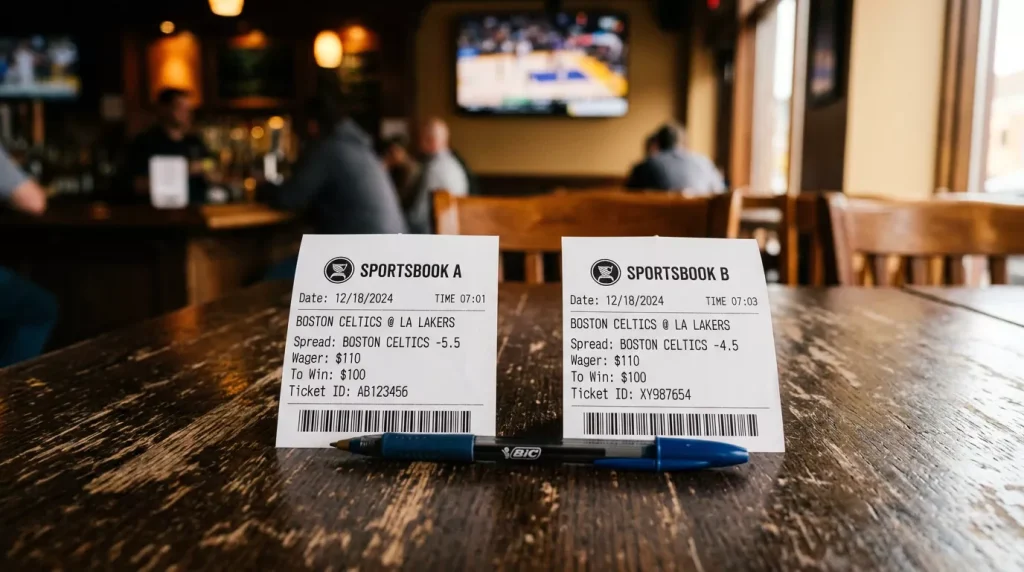
NBA Middling Mechanics: Step-by-Step Line Exploitation
The first time I hit a middle, I thought I had discovered a glitch in the matrix. I had bet both sides of a spread on the same game and both bets won. Not because of an error — because the final margin landed between the two numbers I had bet at. That moment felt like alchemy. The reality, as I quickly learned, is that middling is not magic — it is a disciplined strategy built on line movement and probability.
Here is how it works. Suppose the Celtics open as 3.5-point favourites over the Pacers. You like the Celtics at -3.5, so you bet 100 pounds at decimal odds of 1.91. Over the next 24 hours, the line moves to -6.5 — perhaps because public money has poured in on the Celtics, or because an injury to a Pacers starter has widened the spread. Now you bet 100 pounds on the Pacers +6.5 at 1.91.
You have two open bets. If the Celtics win by exactly 4, 5, or 6 points, both bets win. Your Celtics -3.5 bet cashes because they won by more than 3.5. Your Pacers +6.5 bet cashes because the Pacers lost by fewer than 6.5. You collect 91 pounds profit on each bet, totalling 182 pounds — a double win on a single game. If the Celtics win by 7 or more, your Celtics bet wins (+91) and your Pacers bet loses (-100), netting -9 pounds. If the Celtics win by 3 or fewer (or lose), your Pacers bet wins (+91) and your Celtics bet loses (-100), netting -9 pounds.
The beauty of the middle is the asymmetry: you risk 9 pounds on each outside scenario but gain 182 pounds when the final margin lands in the window. The catch is that the window (in this case, the Celtics winning by 4-6) is relatively narrow. Across thousands of NBA games, the probability of any specific three-point window is roughly 10-14%. That means the middle hits about one in eight times at best — but the payoff when it hits dramatically exceeds the cost when it misses.
Spotting Middling Opportunities Across UK Bookmakers
Middles do not appear on every game. They require significant line movement — at least 2.5 to 3 points of spread shift — to create a window wide enough to justify the risk. On a typical NBA night, only one or two games might offer a genuine middling opportunity, and some nights offer none at all.
The setup starts with your initial bet on a game where you have a directional opinion. You bet the side you like at the opening number, then monitor the line throughout the day. If the line moves 3 or more points in your favour — meaning the market is moving toward the side you already bet — you have a potential middle. At that point, you bet the other side at the new number to lock in the window.
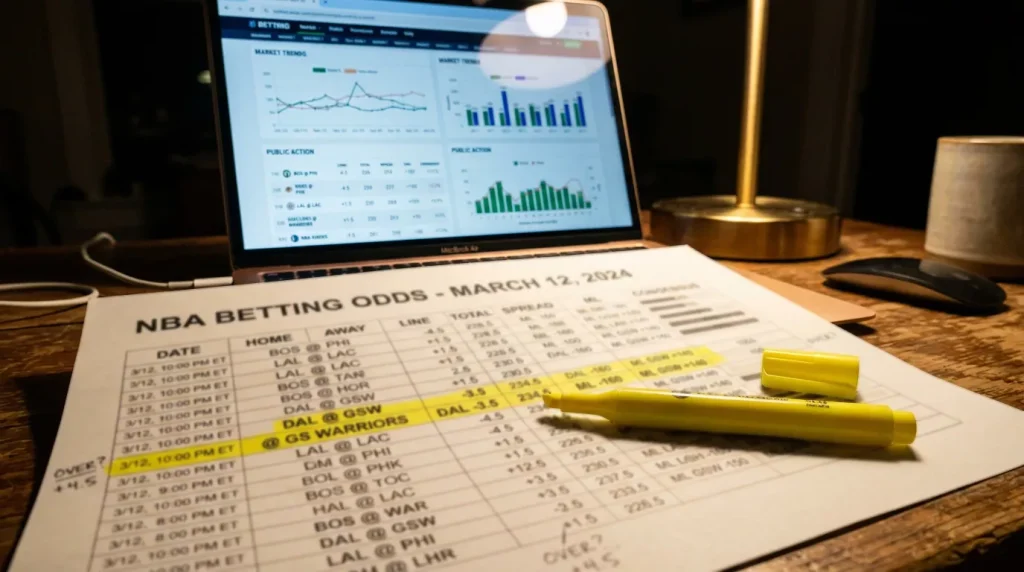
UK bettors have a structural advantage for middling because they maintain accounts across multiple platforms, and different bookmakers do not always move their lines at the same speed. FanDuel and DraftKings together control roughly 75% of the US betting handle, and their line movements propagate to UK platforms with a slight delay. If one UK platform still shows -4.5 while another has already moved to -6.5, you can bet each side at a different bookmaker and create a wider middle than you would find on any single platform.
The key numbers in NBA middling are 3, 5, 7, and 10. These are the most common final margins in basketball, and lines that pass through these numbers create higher-probability middles. A spread moving from -2.5 to -5.5 creates a window that includes the popular margin of 3, 4, and 5 — a three-point window that captures a disproportionate share of NBA game outcomes. A spread moving from -5.5 to -8.5 includes 6, 7, and 8 — a window that captures the equally common 7-point margin.
Risk-Reward Profile of NBA Middling Bets
Middling is not a get-rich strategy. The expected value of a middle depends entirely on the width of the window and the commission you pay on each leg. With standard decimal odds of 1.91 on each side, you lose 9 pounds for every 200 wagered when the middle misses. You gain 182 pounds when it hits. If the middle hits 10% of the time, your expected value is: (0.10 x 182) – (0.90 x 9) = 18.2 – 8.1 = +10.1 pounds per attempt. That is a positive expectation, but the variance is enormous — you will endure long stretches of small losses punctuated by occasional windfalls.
The break-even frequency for a standard two-leg middle at 1.91 odds is approximately 4.7%. If the middle hits more often than that, you profit. A three-point window in the NBA hits roughly 10-14% of the time depending on where the window falls, so the maths supports the strategy in principle. But that 10-14% frequency assumes you are creating windows at the right numbers, which requires both line movement and the discipline to pass when the window is too narrow.
I allocate no more than 5% of my monthly betting volume to middling attempts. The rest goes to straight bets where I have a directional edge. Middling is a supplement to a sharp betting system, not a replacement for one. The bettor who middles every possible opportunity without having an initial directional opinion is just paying commission on both sides of a bet and hoping to get lucky — which is the opposite of systematic betting.
One risk that UK bettors should be aware of: some bookmakers monitor accounts that consistently bet both sides of a spread and may restrict your account if the pattern is obvious. Spreading your activity across multiple platforms and mixing middles with regular straight bets reduces this risk. The goal is to look like a normal bettor who sometimes changes his mind, not like a professional exploiting price discrepancies — even if the latter is exactly what you are doing.
For a deeper understanding of the forces that drive the line movements necessary for middling, my piece on NBA line movement strategy covers the mechanics of sharp money, public bias, and injury-driven adjustments.
Articles

Created by the "CourtEdge" editorial team.
