
NBA Betting Odds Comparison: Finding Best Prices in the UK
 Available in US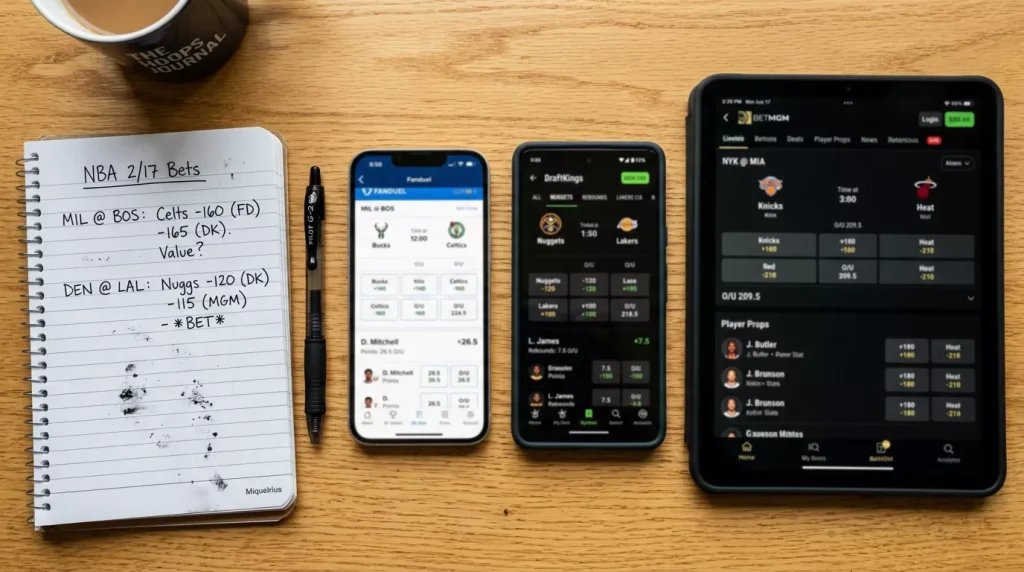
Comparing UK Bookmakers: Finding Maximum NBA Odds Value
Three seasons ago I ran a side experiment: I placed identical bets on 100 NBA games, but split each bet between the best available price and the first price I saw. Same selections, same stakes, different odds. After 100 bets, the best-price portfolio was up 7.2 units. The first-price portfolio was down 1.4 units. Same bets. Same teams. The difference was entirely in the price I paid. That experiment ended my laziness about odds comparison permanently.
UK-licensed platforms vary considerably in their NBA coverage. The major operators offer spreads, totals, moneylines, and basic player props on every game. Some go further with alternate lines, team totals, quarter and half markets, same-game parlays, and exotic props like first basket scorer and race to a set number of points. Online sports betting revenue from real events in the UK hit 596 million pounds in the January-March 2025 quarter, and the competitive pressure among operators means NBA coverage keeps expanding as each platform tries to differentiate.
Coverage breadth matters because deeper markets mean more opportunities to find mispriced lines. A platform offering only spreads and totals gives you two angles per game. A platform offering spreads, totals, team totals, quarter lines, and 15 player props gives you 20 or more angles. Not every angle will show value, but the platform with more markets provides a larger canvas for your analysis. The number of licensed gambling premises in the UK sits at 5,825 as of early 2025, but online is where the NBA action lives — and online platforms compete on market depth as aggressively as they compete on price.
Odds Comparison Tools and Sites for UK NBA Bettors
Checking five bookmaker sites manually before every bet sounds tedious. It is. That is why odds comparison tools exist, and for NBA betting from the UK, they are indispensable.
Comparison sites aggregate prices from multiple UK-licensed bookmakers and display them side by side for each game and market. You search for the Celtics-Lakers spread, and the site shows you the best available price on each side across every bookmaker it tracks. The savings are immediate and require zero analytical skill — you are simply buying the same product at a lower price.
I use comparison sites as a screening tool, not as the final step. The prices they display sometimes lag the actual bookmaker sites by two to five minutes, and NBA lines can move in that window — especially after injury news. My workflow: check the comparison site to identify which platforms are likely to have the best price, then navigate directly to those platforms to confirm the number and place the bet. This adds about 30 seconds per bet and ensures I am acting on live prices rather than cached ones.
Some comparison sites also track historical odds movement, which is useful for understanding how a line has shifted since opening. If a spread opened at -3.5 across the market and has moved to -5 on all platforms except one that still shows -4, that lagging platform represents a temporary value opportunity. These discrepancies appear most often on early-morning NBA lines that UK platforms post before their trading desks are fully staffed, and they close quickly once the bookmaker catches up.
A word of caution: not all comparison sites cover all UK bookmakers. Some only track the five or six largest operators. If you have an account with a smaller platform that occasionally offers outlier NBA prices, you will still need to check it manually. I keep a shortlist of three platforms that the comparison sites miss and check them alongside the aggregated results.
Understanding Bookmaker Margins on NBA Lines
Every NBA line includes a built-in margin — the bookmaker’s commission for hosting the market. Understanding how that margin works is essential for evaluating whether a price represents genuine value or just a standard offering with the house edge baked in.
On a standard NBA spread, both sides are priced at approximately 1.91 in decimal odds. If you convert both sides to implied probabilities (1 / 1.91 = 52.36%), they sum to 104.7% rather than the 100% that would represent a fair market. That extra 4.7% is the bookmaker’s margin, also called the overround or vigorish. It means you need to win approximately 52.4% of your spread bets just to break even.
Margins vary across markets and across bookmakers. Spreads and totals on major NBA games typically carry margins between 4% and 6%. Player props carry wider margins — often 7% to 10% — because the bookmaker faces higher uncertainty and needs a larger cushion. Same-game parlays can carry effective margins of 15% or more once the correlation adjustments and individual leg margins compound. The UK betting market generates 16.8 billion pounds in annual gross gaming revenue, and a significant portion of that revenue comes from the margin structures that most bettors never examine.
When comparing odds across bookmakers, the margin tells you who is offering the most competitive price. If Bookmaker A prices a spread at 1.91/1.91 (4.7% margin) and Bookmaker B prices the same spread at 1.93/1.87 (4.1% margin on the 1.93 side), Bookmaker B is giving you a better deal on that specific side. Over hundreds of bets, consistently taking the lower-margin price adds 0.5% to 1.5% to your annual ROI — which does not sound like much until you realise that most profitable bettors operate on edges of 2-4%.
I keep a running log of which platforms consistently offer the tightest margins on NBA spreads, totals, and props. The ranking shifts over time as bookmakers adjust their pricing strategies, so I update it every few months. This log tells me where to look first for each market type, saving time on the comparison process and ensuring I am not leaving money on the table.
One final point on margins that caught me off guard when I first ran the numbers: the effective margin on a parlay is dramatically higher than on a single bet. A two-leg parlay at standard pricing carries roughly double the single-bet margin, and a four-leg parlay approaches four times the margin. This is why sharp bettors overwhelmingly prefer straight bets — the margin penalty compounds with every additional leg, and the bookmaker keeps a larger percentage of the total wagered. If you are going to bet parlays, at least ensure each individual leg is placed at the tightest available price. Line shopping becomes even more critical for multi-leg bets than for singles, because the compounding margin amplifies every fraction of a percentage point you save. For the broader framework on why price matters as much as selection, my guide on NBA betting for UK beginners covers the fundamentals.
Articles




Prepared by the CourtEdge editorial staff.
