
NBA Betting Market Efficiency: Understanding Closing Line Value
 Available in US
NBA Closing Line Value: Beating Bookmaker Efficiency
Every sharp bettor I respect measures one thing above all others: closing line value. Not win rate. Not ROI over a hot month. Closing line value — CLV — is the difference between the odds you bet at and the odds the market closes at. It is the purest measure of whether you are genuinely outsmarting the market or just getting lucky.
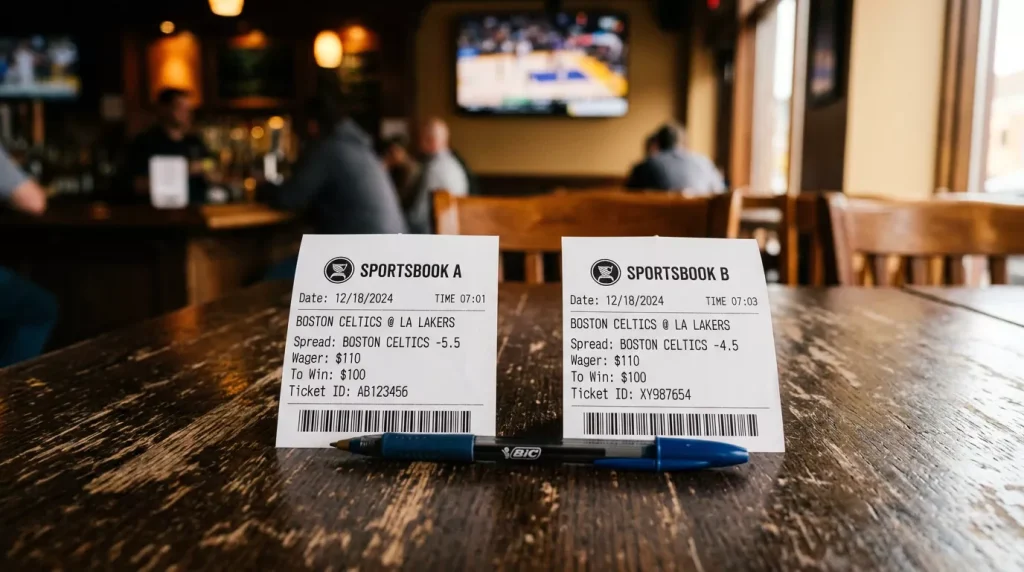
Here is how it works. Suppose you bet the Bucks at -3.5 when the line opens Tuesday afternoon. By tip-off Thursday night, the line has moved to -5. You got the Bucks at -3.5 when the market’s final assessment was -5. That 1.5-point improvement is positive closing line value — you captured a price that the market later determined was too generous. Over hundreds of bets, consistent positive CLV is the strongest predictor of long-term profitability.
Why does CLV matter more than win rate? Because the closing line is the most accurate prediction the market produces. It incorporates all available information — sharp money, public betting, injury confirmations, lineup news — and distils it into a single number. A bettor who consistently beats the closing line is extracting information the market has not yet priced in, which is the definition of edge. A bettor who wins 55% of bets but does so at the closing line is just experiencing positive variance that will revert over a larger sample.
I track my CLV for every bet in a spreadsheet. The average is small — usually 0.5 to 1.5 points of spread value — but it compounds. Over 300 bets per season, averaging one point of CLV translates to a meaningful edge that survives the variance NBA betting inevitably produces. If your CLV is consistently negative, you are not beating the market regardless of your current win rate.
Where NBA Markets Remain Inefficient: Props, Totals, and Early Lines
The efficient market hypothesis says you cannot consistently beat a liquid, well-arbitraged market. NBA spreads at closing time come close to satisfying that hypothesis — the closing line is extremely accurate on average, and finding consistent edge against it is genuinely difficult. But the NBA betting market is not a single monolithic entity. It is a collection of sub-markets, each with different levels of liquidity, attention, and pricing precision.
Player props are the least efficient NBA sub-market. The reason is structural: bookmakers must set hundreds of individual prop lines per game, and they cannot devote the same analytical resources to each one that they devote to the headline spread and total. A star player’s points line gets careful attention. A role player’s rebounds prop? Less so. That asymmetry creates soft spots that diligent researchers can exploit.
Totals are more efficient than props but less efficient than spreads, particularly in the early-line window. When totals open 18-24 hours before tip-off, they reflect the bookmaker’s model plus limited market input. Over the following hours, sharp action and public money push the total toward its closing value. The gap between the opening total and the closing total averages about 1.5 points across a full season, and bettors who can identify the direction of that movement before it happens capture meaningful value.
In-play markets represent a growing frontier of inefficiency. Live NBA lines are generated by algorithms that react to scoring, possession changes, and time remaining. Those algorithms are sophisticated but imperfect — they struggle with context that a human observer can read instantly, like a coach’s decision to rest starters in a blowout or a team’s shift to a zone defence mid-quarter. In-play betting accounted for 62.35% of online betting revenue in 2025, and the speed at which money flows into these markets is growing faster than the pricing algorithms can keep up. Americans wagered over $166.94 billion on sports legally in 2025, and a rising share of that volume targets live markets where the edges are widest.
How NBA Market Efficiency Has Changed Since Legalisation
The repeal of PASPA in 2018 changed the NBA betting market permanently. Before legalisation, the market was fragmented — a mix of Nevada sportsbooks, offshore sites, and underground bookmakers operating without transparency or coordination. Since then, more than $500 billion has flowed through legal American sportsbooks, and that liquidity has tightened NBA lines considerably.
The closing line has become more accurate year over year. The average absolute spread error — how far the final margin deviates from the closing spread — has decreased since 2018, meaning bookmakers are getting better at predicting game outcomes. This is not surprising: more data, more sharp money, and more sophisticated models all push the market toward efficiency. For bettors, it means the edges that existed in 2019 or 2020 are often smaller or gone entirely.
But legalisation also created new inefficiencies. The explosion of prop markets, same-game parlays, and in-play betting products introduced sub-markets that bookmakers have not had time to optimise fully. The market is more efficient where it has always been liquid (spreads, totals) and less efficient in the newer products that generate revenue through volume and margin rather than pricing precision.
There is a counterintuitive dynamic at work here that I think most bettors miss. As the main markets (spreads, moneylines) get more efficient, bookmakers invest more heavily in the higher-margin products — props, parlays, micro-markets — because that is where the revenue growth lives. The analytical resources that could make those secondary markets more efficient are instead directed toward expanding their catalogue. More markets means more opportunities for bettors who do the homework, even as the headline markets get tighter. The global sports betting market is projected to reach $325.71 billion by 2035, and the growth will be driven largely by these newer products — which means the inefficiency window may stay open longer than the efficient-market purists expect.
The practical conclusion for UK bettors: do not waste your energy trying to outsmart closing spreads on marquee NBA games. That market is close to efficient, and the edge available is razor-thin. Instead, focus your research where the market is still learning: player props, early lines, live betting, and niche totals markets like first-half and quarter totals. These are the sub-markets where preparation beats the algorithm, and where your time investment produces the best return. For the foundational framework on identifying where value lives, my guide on value betting in NBA markets walks through the expected value calculations step by step.
Articles


Prepared by the CourtEdge editorial staff.
